Full Range of Opinions
Weekly Wisdom
Episode 42
It is remarkable how two people, looking at the same evidence, can come to completely opposite conclusions. CrossFit founder Greg Glassman is a case in point. He looked at the existing sport science of his day and came to a conclusion that was at odds with the entire health and fitness industry. Over time, science and results have proven him correct.
If your gym has kettlebells, gymnastics rings, bumper plates, lifting platforms, C2 rowers, medicine balls, plyo-boxes, or a functional fitness room, you have Glassman to thank for it. No, he didn’t invent any of those things, but their resurgence in popularity is a result of CrossFit’s success. If you train at F45 or Orangetheory or any other gym that prioritizes full-body, functional movements and blends strength and conditioning, then you are the beneficiary of CrossFit’s paradigm-breaking approach to fitness.
A Debate Worth Revisiting: Range of Motion
CrossFit diverged sharply from the status quo in too many ways to count in one brief article, so today I will just look at one: full range of motion. I chose this topic because one of our Empower coaches is currently taking her ACE personal trainer certification to broaden her knowledge as a fitness professional. It is a funny reversal, seeing as I started with ACE before discovering CrossFit, and she started with CrossFit before going for ACE. The transition has been difficult for her on many levels. The first one she brought to my attention is the old full range of motion debate.
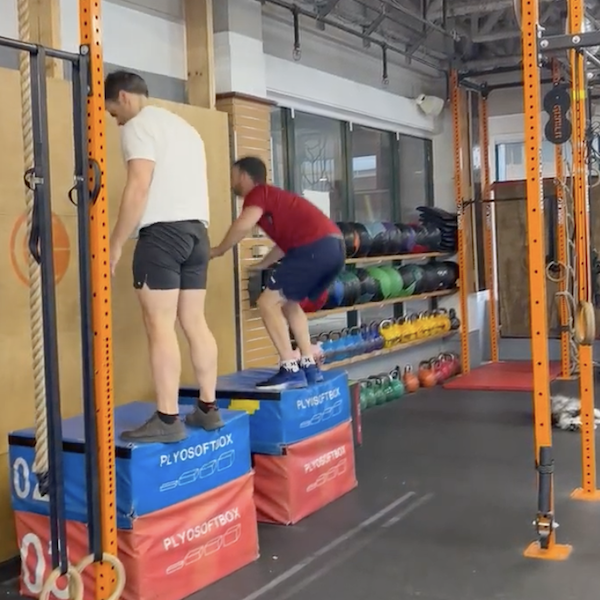
What we know is that you are weakest at your end range of motion about any given joint. This is where your muscles have the least mechanical advantage and where you are most likely to incur injury. We all know this. We all agree on this. So why does CrossFit insist you train through the full range of motion on every rep while the rest of the industry advises you not to?
There’s not a lot of mystery to it. In fact, the fitness industry's fear of full range of motion exercises can be summed up in one word: liability. They don’t want you getting hurt on their watch. What happens to you outside the gym, well, that’s your problem. As long as the arrow of blame cannot be pointed in their direction, they are off the hook. This is a blatant case of PTOA (Protect Their Own Asses). They’re not avoiding training you through a full range of motion for your benefit but for their own.
Strong in the Gym, Fragile in the Real World
This would be fine if your life outside the gym was all bicep curls and lat pull-downs. The problem is that life beyond the Hammer Strength and Nautilus machines requires you to move through a full range of motion whether or not you’re weak there. And guess what? Thanks to trainers who have made you really strong in a limited range of motion while neglecting the end ranges, you have major strength deficits that now predispose you to injury the moment you extend beyond your trained range. So, they have built an athlete who can perform partial leg presses at five hundred pounds but is going to tear his hamstring the moment he tries to sprint.
It would be one thing if you were weak all around. If you believed yourself weak, you would move through the world avoiding anything that might strain you, but because your trainer has you lifting heavy loads in the gym, you feel strong and confident. It is not until life points out your deficits that you discover your fitness does not measure up to real-world challenges. How demoralizing is that?
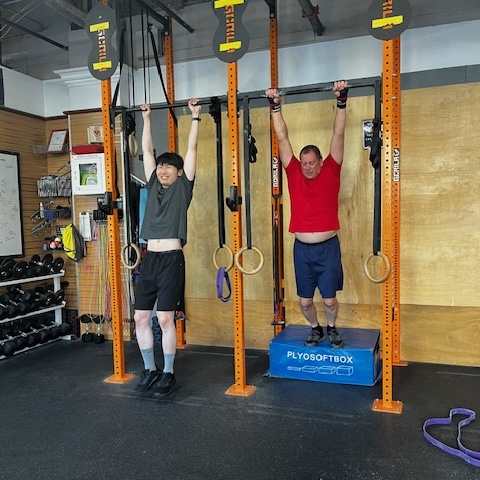
In contrast, Greg Glassman is committed to making you fit for whatever life throws your way. In CrossFit, we are training for the real world. If life is going to test us through a full range of motion, Glassman reasoned, wouldn’t be better if we developed that capacity in the controlled environment of the gym first?
Oh, Glassman’s detractors derided him in the early days, saying he was going to injure all his athletes and labelling CrossFit as dangerous. I know that’s what I thought based on my ACE training when I first stumbled upon CrossFit. But Glassman’s reasoning was compelling enough that I decided to test his methodology if only to prove him wrong.
Results That Speak for Themselves
Only he wasn’t. I’m fitter and more resilient today in my 50s thanks to CrossFit than I ever was in my 20s following the ACE training recommendations. And not just me. Every day, we see incredible transformations in the gym as we change lives for the better and make broken bodies strong again through CrossFit’s incredible alchemy. The CrossFit Games proved beyond a shadow of a doubt that Glassman’s revolutionary approach to training produces results superior to anything that existed before.
And here’s the bit that folks always miss: CrossFit is not a static, predetermined methodology. CrossFit is a training system that prioritizes outcomes, continually evolving to incorporate best practices. To paraphrase Greg Glassman: We are not committed to the methodology, we are committed to the results. If you come up with a training regimen that produces better fitness outcomes, we’re just going to do that and call it CrossFit.
The problem is that most people are either too lazy or lack the ability to think through second-order consequences, and the fitness industry in general is not known for attracting the brightest bulbs. At first blush, the advice to “avoid training athletes in their weakest range of motion because it will increase injury risk” sounds like wisdom. Anyone ignoring this might be labelled negligent. But that’s only if you do not consider the consequences of this training deficiency and how they affect the athlete in the world beyond the gym. But that would require thought, and as Glassman discovered in his day, thought is something that has long been missing from the fitness industry.
And that’s why two people looking at the same piece of information can come to two very different conclusions and how two people choosing very different training paradigms can come to two very different fitness outcomes. Yes, you will always be weakest and most susceptible to injury at the end range of any joint. And that is exactly why it is important that you train that full range in the controlled setting of the gym before life comes along and punishes you for it.