Reconsidering the Squat
Weekly Wisdom – Episode 35
March 28, 2026
Trigger warning: what you are about to read flies in the face of the CrossFit orthodoxy and might sound heretical to some. It is an opinion I first heard from Mark Bell, though my personal training had already shifted, by necessity, in this direction.
Who Is Mark Bell (And Why This Matters)
To give you a bit of background on Mark Bell, he rose to fame as a power lifter back squatting 1000lbs in competition. It is important to point that out before we get started in light of his current position on the subject because it underlines the fact that Bell knows something about back squatting. Arguably more than most of us. Mark also used to run the CrossFit power lifting seminars, touring around the country training coaches and athletes alike in the back squat.
More recently, he has been the host of the Mark Bell Power Project podcast, where he brings on and works with leading experts in health, fitness, and sports performance. He is one of the industry experts who helped convince me to fly to San Diego to check out Weck Method and rope flow. These days Bell participates in BJJ, has taken on long-distance running and also sprints, a remarkable athletic transformation from his power lifting days.
So what’s Mark’s contrarian position? Well, in this video he questions the benefits of back squatting to full depth with load. Now, I know that is a controversial statement since powerlifting and CrossFit require us to reach full depth (thighs below parallel) for the lift to even count. And look at Olympic lifters; those guys and gals are ass-to-grass. Besides, anyone who’s been paying attention to the exercise science also knows that full-depth squats are important for preserving knee health. So, what gives?
The Problem With Loading Full Depth Squats
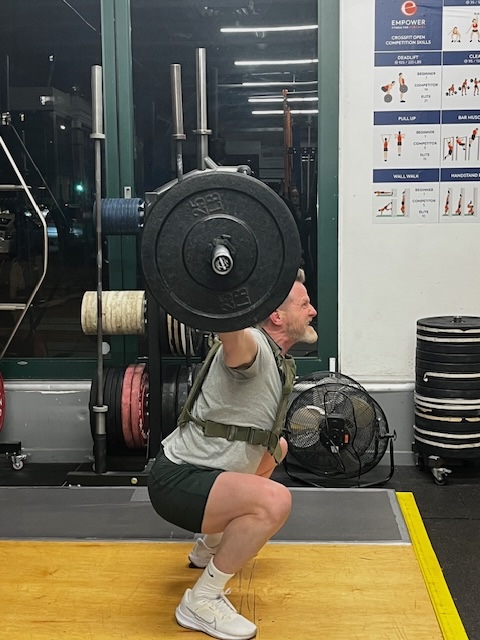
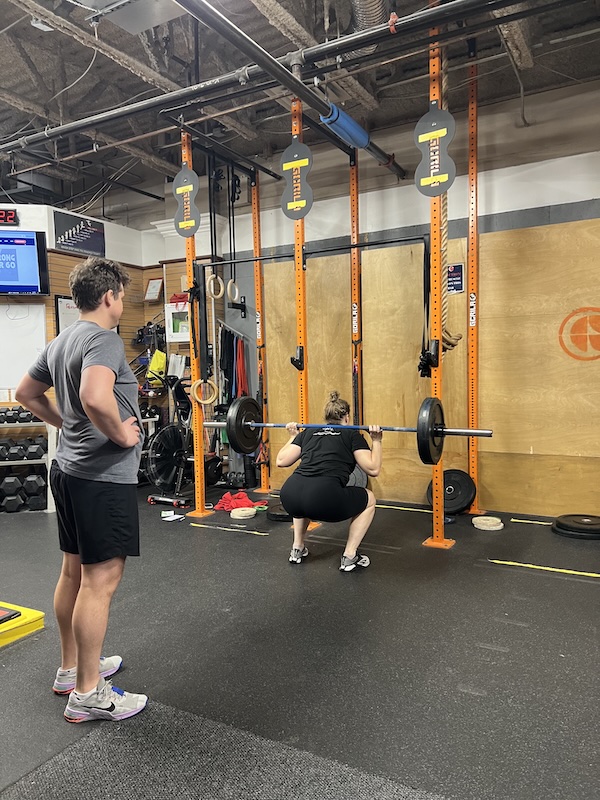
Well, Mark points out that squatting to full depth under load inevitably puts the lifter’s joints in compromised positions. Whether it is the toes turning out, the arches, ankles or knees caving in or the pelvis tucking under (butt wink), to achieve a deep squat under load, something has to give. And maybe that is not ideal.
Separate Depth From Load
Now, before you totally lose it, Mark is not suggesting you should never squat to full depth, and he is not saying you shouldn’t do heavy back squats. He is proposing instead that you separate the two. He absolutely believes you should master a full-depth squat. Evolutionarily, this is a default resting position for the human body, and your functional strength and mobility can be measured by the comfort you feel maintaining this position. If you don’t own it, it is a goal you should be working toward. What he is arguing here is that loading the human body in what resembles a natural resting position may not be ideal. It is, after all, a rest position. Not a loading position. In a rest position, your structure is not aligned optimally for producing force. So, deep squat, yes; loaded, no.
Strength Development Considerations
But what about your strength development, you ask? The back squat, the king of lifts, is the most effective way to develop full-body strength. Absolutely. Mark is with you there. But he suggests that your loaded back squats should consist of box squats and quarter squats, variations that allow you to move heavy loads without placing you in mechanically compromised positions. In fact, Louie Sears and the boys at Westside Barbell, who set all those powerlifting world records, rarely squatted without boxes outside of competition. And I know this idea is anathema to the CrossFitters’ ears because it hurts to think about doing a back squat workout that “doesn’t count” because it wasn’t Rx.
Considering Multiple Perspectives
But look, one man’s opinion is only that. Never mind that Mark’s idea resonates with the experience I have personally as an ageing CrossFit athlete who has a full-depth squat but has struggled in recent years with loading it at full depth. Never mind that I have seen most of my 10-year CrossFit athletes begin to suffer from injury and mechanical breakdown. What I always look for in these cases are converging opinions from disparate sources.
Additional Expert Insight
Now, Lee Weiland is not as well known as Mark Bell, not by a long shot, but I’ve been following him and his Powerbatics program for several years now and like what he’s putting out. He is helping people develop strong, athletic bodies. In this video, he explains why he does not believe that heavy squats are the best way to develop leg strength or hip mobility.
He is backed up by Cheng Xie, the world’s leading expert in fascia. There is too much to unpack in this video for this post; it will require a post all its own, which I look forward to writing at a later date because Cheng’s HFT methodology is just mind-blowing. But in addressing the athletic strength benefits of back squatting verses explosive plyometric training, Cheng points out that a double body weight back squat with a barbell would be considered a respectable lift but comes nowhere close to the 4x bodyweight load placed upon your legs when sprinting, jumping or performing acrobatics. So why waste time lifting submaximal loads that put your skeletal structure at risk when you could be maximizing your strength potential with bodyweight movements? You’ll never meet a sprinter with weak legs. And that strength is not developed in the gym.
What Elite Athletes Are Doing
And then, here’s the kicker. Because CrossFit has always spat in the face of sports science theory. We are all about measurable outputs in the real world. Well, here’s where our convergence comes full circle. Because I follow other athletes and professional coaches and I see what they are doing in their training. And very few elite athletes training with world-class coaches are performing full-depth squats under load to train leg strength.
Here is a great example that I happened upon at the time I was ruminating Mark Bell’s unexpected position on the subject. And I realize you know nothing about Judo or Hisayoshi Harasawa so, you’ll just have to take me at my word that he is a great example of a tip-of-the-spear world-class athlete competing in a sport that probably comes second only to wrestling for its complete athletic demands. Watch and you’ll see Harasawa front squat to a box and do quarter-depth back squats but, you’ll never see him perform a loaded squat to depth. Yes, his judo training will see him duck walking and dropping into a full squat to throw his training partners but, in the gym, under load, his trainer keeps him above parallel. You will see this bias repeated across sports wherever professional coaches and elite athletes converge.
Final Thoughts
There’s something to think about here. Mark Bell may have stumbled on a truth worth considering. For some of you, it will be hard to hear. My goal isn’t to convince you; it is only to plant a seed. Carry on training the way you believe is best, but maybe pay attention to your body while you do and check in from time to time to consider whether how your training is actually working for you.
For the rest of you, those of you who struggle to squat to depth and were relieved by the notion that you don’t have to train that deep mobility anymore, I want to double click on the fact that none of the experts cited above, not Mark Bell, not Lee Weiland, not Cheng Xie, not a single trainer worth their salt anywhere in the world, ever said you shouldn’t be squatting to depth. You absolutely should. In fact, you should prioritize owning a full-depth unloaded squat before you even think about picking up a barbell. A full-depth squat is non-negotiable. If you are lacking this capacity, you have a strength and mobility deficit that needs to be addressed before you start lifting heavy, or else any strength you build will be upon a faulty foundation. Box squats, quarter squats, you are going to be injury-prone and brittle no matter what you do if you do not first develop a full-depth unloaded squat.
So, get after it. Go out and master that deep squat, and go ahead and squat heavy. Maybe just reconsider combining the two.