Strength and Conditioning Made Simple
Weekly Wisdom - Episode 39
April 25, 2026
If you do not know who Pavel Tsatsouline is, he is the person who popularized Russian kettlebell training in North America and brought with him many Soviet-era strength training secrets. In the video shared here, he discusses three basic Soviet strength training methodologies, but that is three times as complex as you or I need. In fact, you can build lifelong strength by following just the first method: Step Loading.
The Step Loading principle inspired legendary strength coach Dan John’s famous “Easy Strength” program because it’s easy and it works. For Pavel, for Dan, for the athletes they train, and for you. Easy, safe, effective, sustainable. It departs dramatically from the industry standard progressive overload approach, where athletes seek to continuously add weight to their lifts.
How does it work? Pick a weight and a rep range and repeat regularly, never increasing load or volume until it becomes easy. When it’s easy, add load and repeat. This allows the time required for all your connective tissue to adapt before increasing the load, resulting in safer, more sustainable progress. It also reduces the psychological stress associated with progressive overload of wondering if you can keep adding weight (spoiler alert: you can’t). With Step Loading, there is never any doubt. You just keep doing the same thing you did last session until it feels too easy.
The problem with this method is not that it isn’t effective; it’s that it is too simple. People love bells and whistles. They’re drawn to complexity. The more complicated the program, the more advanced it seems. It is the dilemma of the complex thinker. And yes, there are thousands of trainers out there who will want to tell you otherwise because there're bucks to be made by baffling folks and safeguarding the secrets of strength. They hate Step Loading because it is so easy that you can get strong without them.
But if you’re serious about sustainable results, keep it simple: pick a weight, master it. Then add load and repeat.
Athletic Conditioning
Does your performance degrade under fatigue? Yes, you train strength and you do cardio but, you fall apart and feel gassed the moment you have to combine the two. CrossFit is a unique strength and conditioning methodology in that it programs high-skill, high-effort movements such as complex gymnastics or heavy Olympic lifts within the framework of a metabolic conditioning workout, testing whether you can perform under fatigue.
This is a departure from the standard of separating strength and conditioning training, and that is why CrossFit has produced fitness results transferable to other sports. Athletic conditioning can be defined as your ability to repeat high-quality efforts. Can you still clean and jerk 185lbs when you are winded? Can you perform a muscle-up when your heart is bursting out of your chest and your limbs are quivering? Training these skills in isolation will never produce that ability. And that is how the CrossFit metcon changed the fitness industry.
But even in CrossFit, the scoreboard rewards consistent low effort over high-skill, high-effort performance. Standard CrossFit workouts tend to produce athletes who are not explosive enough to be athletic, and not conditioned enough to repeat high-output efforts.
This is where interval training comes in. The fixed timeline of interval training provides a conditioning stimulus while still allowing sufficient rest to recover between high-effort movements. I like the EMOM or E2MOM format for training this, but there are many other interval options. Our Saturday team WODs frequently focus on this type of conditioning; the turn-taking of partner workouts usually provides a great work to rest ratio.
This is not to knock Zone 2 cardio or strength training days, which both have their place. But neither of those alone will make you athletic. Once again, complexity is not required. Pick a high-effort movement. Pick a rest interval. Go to it. Note when your performance begins to degrade. That will show you where your current capacity is.
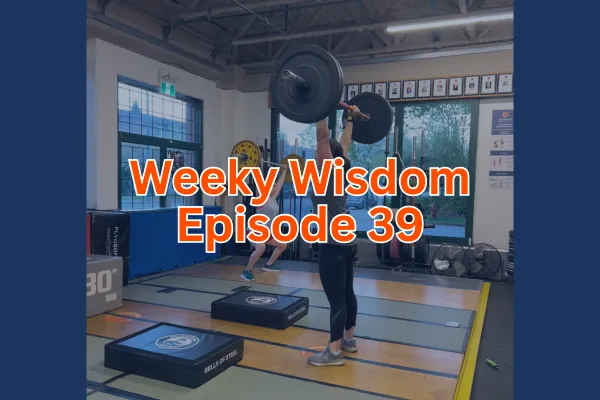
An example of this is the 5-round Clean & Jerk E2MOM I recently completed.
In the first round, starting at zero on the clock, I completed 5 consecutive clean & jerks at 155lbs.
Then I added weight, and at minute 2, I completed 4 clean & jerks at 165lbs.
At minute 4, I did 3 clean & jerks at 175lbs.
2 at 185lbs at the 6-minute mark.
And finished at 8-minutes with 1 clean & jerk at 195lbs.
Five high-effort sets performed in under 9-minutes. Rests long enough to recover in order to execute with a high degree of skill but short enough that my heart rate remained elevated for the duration. And because those loads felt easy, next time I will increase the load by 5lbs in each of the 5 sets.
And none of this is to say that complex programs won’t work. If you’re following a complex program that you love and are happy with the results, keep going. But if you just want a simple way to produce reliable results and are confused about how to get started, hopefully these insights will help empower you on your fitness journey. Simple works.
