
Are Your Shoes the Problem? The Case for Barefoot Training
Weekly Wisdom #65
I used to turn my ankle every couple of months. It was annoying.
In 1997, when Sunghee and I first started dating, I was on crutches after spraining my ankle. I spent much of the next year in an air brace. Every time I went out for a run, I was at risk of twisting it again. And I often did.
Until I discovered barefoot running.
In 2008, I first started training in Vibram FiveFingers. I haven't twisted an ankle since. Not once in 18 years!
And it's not as though I've been taking it easy.
During those years, I've been active in CrossFit and judo. I've broken my foot tripping over a tree root, taken a bad step off a curb, fallen over a rower, stepped on a PVC pipe left lying on the gym floor, and been thrown badly on the judo mat.
All without a single ankle sprain.
Can you believe it? A lifetime of recurring ankle injuries ended by simply ditching my shoes?
What I had blamed on weak ankles turned out to be caused by the shoes I was wearing.
Four Ways Your Shoes Undermine Your Balance and Stability
Did you realize that the construction of most conventional athletic shoes actually contributes to ankle instability?
Here's how.
1. Too Much Cushioning Makes Balance More Difficult
Imagine trying to balance while standing on your bed's mattress.
Now imagine standing on your bedroom floor.
On which surface do you feel more stable?
Most athletic shoes place you on a soft, impact-absorbing cushion. The problem is that balancing on a soft surface is harder than balancing on a firm one.
Now imagine navigating your day with mini bed mattresses laced to your feet.
Your feet contain an extraordinary network of muscles, joints, and sensory receptors that help you detect changes in the ground and adjust your balance. Thick cushioning interferes with that connection.
2. Thick Soles Raise Your Centre of Gravity
The thicker the sole, the higher your centre of gravity.
Most of us don't walk around wearing stilts because we understand that doing so requires amazing balance.
The higher your shoes lift you off the ground, the more strength, balance, and coordination you need to resist the call of gravity.
You're building yourself up for a fall.
3. Narrow Toe Boxes Restrict Your Natural Base of Support
Your toes are designed to spread out, creating a wide, stable base.
The ability to press your big toe into the ground is essential for maintaining balance and generating force.
But look at the shape of most conventional shoes. They squeeze your toes together rather than allowing them to spread naturally.
The shape of your shoe's toe box limits your toes' ability to adjust as needed.
If you're trying to improve your balance, squat more effectively, or maintain the foot strength necessary for everyday movement, why would you deliberately restrict the very structures designed to stabilize you?
4. The Shape of the Sole Creates Ankle Instability
Finally, the architecture of many running shoes resembles a pyramid, with a wide base at ground contact tapering up toward a narrower point at—you guessed it—your ankle joint.
That's right. The failure point is built right into the shoe design.
The weakest point in the structure is your ankle.
Combine that with thick cushioning and an elevated sole, and you've created a recipe for instability.
So, if you've been tripping, falling, and turning your ankle like I so often did, it may not be your weak ankles that are the problem.
It may be your shoes.
What Changed When I Started Training Barefoot?
Since 2008, I've been the crazy guy shouting about the benefits of freeing your feet from your shoes.
But recently, some others at Empower have taken up the torch.
The Ghost and Roxy were early adopters. More recently, Coaches Motor and Salsa have discovered how game-changing barefoot training can be.
It just feels different.
In a good way.
There's something satisfying about feeling the ground directly beneath your feet. Whether you're squatting, deadlifting, or working on your balance, that direct connection changes how you experience movement.
And when it comes to strength training, a stable connection to the floor matters. You want to transfer force efficiently, not lose stability through a soft, compressible sole.
Don't Throw Out Your Shoes Just Yet
Before you throw out your shoes and run unshod through the streets of Vancouver, let me clarify something.
Barefoot sport is not new to me.
I've participated in judo since 1980, and judo is practised barefoot. As a result, I spent decades developing the strength, mobility, and proprioception that made my transition to barefoot exercise relatively easy.
Proprioception, if you're unfamiliar with the term, is your body's ability to sense its position and movement without having to look. It's what helps you know where your feet are, adjust to uneven ground, and maintain your balance.
If you've spent most of your life in shoes, you may have lost much of the foot strength and proprioceptive awareness required for barefoot activity.
That doesn't mean you should suddenly start running five kilometres barefoot.
Just as you wouldn't walk into the gym and attempt a heavy deadlift without preparing your muscles, you shouldn't expect your feet to tolerate a dramatic change in training overnight.
Start small.
Spend a little time barefoot at home. Practise balancing on one foot. Try some simple foot-strengthening exercises. Experiment with minimalist footwear for short periods.
Gradually increase your exposure as your feet become stronger.
Like any form of strength training, the key is to build capacity through manageable doses.
My Favourite Barefoot and Minimalist Footwear Options
Over the years, I've experimented with different minimalist shoes. Here are my favourites, in reverse order.
3. Xero Shoes
Xero Shoes are less expensive than Vivos, have a wider toe box, and make great casual shoes for walking around town.
If you see me outside the gym, I'm usually wearing Xeros.
They're durable, comfortable, and give my feet considerably more freedom than conventional footwear.
2. Vivobarefoot
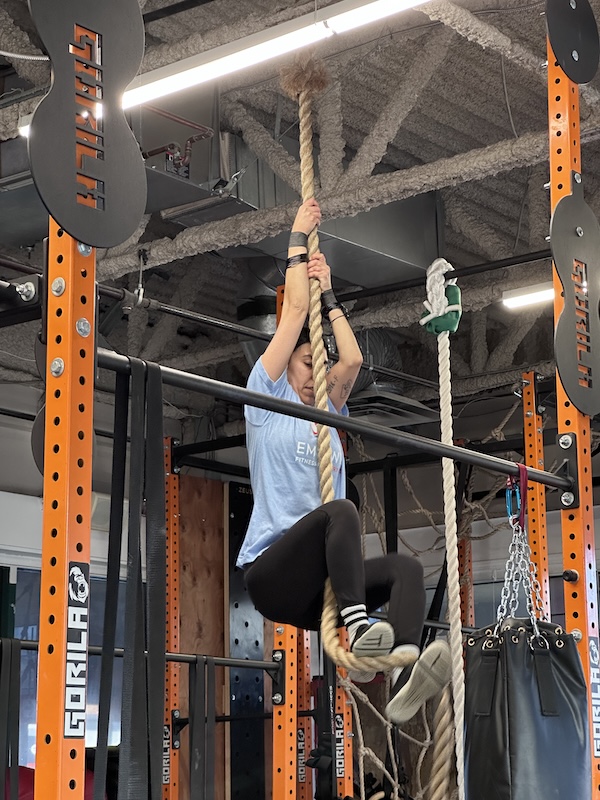
For running and rope climbs, these beat the Xeros.
Vivobarefoot shoes have been my go-to training footwear since 2010. They fit my feet like a glove.
Yes, they're expensive. But they last for years.
I also own a dress pair for formal occasions and hiking boots for wet, snowy, or muddy weather. In Vancouver, those get plenty of use.
1. As Nature Made You
My first choice?
Nothing at all.
I keep a pair of Vivos in my cubby at Empower in case I need to climb a rope or run outdoors. But most of the time, I prefer to train as nature intended: in my bare feet.
No, I don't walk around outside barefoot. I'm not that brave.
But in the gym, I don't think most of us need to spend money on expensive athletic shoes.
In fact, I fear even my beloved Vivos interfere, to some degree, with the opportunity for my feet to interact directly with the ground.
Foot Strength, Balance, and Healthy Aging
Here's where this discussion becomes about something much bigger than shoes.
As we age, maintaining our balance becomes essential to maintaining our independence.
Falls are a major health risk for older adults. They can lead to injuries, loss of confidence, reduced mobility, and, in some cases, a permanent loss of independence.
We tend to think about strength training for healthy aging in terms of the big muscles: legs, hips, back, and core.
And those muscles are enormously important.
But what about the muscles in your feet?
Your feet are the foundation of nearly every movement you make while standing. They help you sense the ground, distribute your weight, stabilize your body, and respond to changes in your environment.
Foot strength, ankle mobility, and proprioception all contribute to balance and functional movement.
And a good deal of the falls that occur among older adults can be attributed to losses in strength and proprioceptive awareness.
I believe decades spent in supportive, overbuilt shoes contribute directly to those losses.
Think about it. If we spend our entire lives cushioning our feet, restricting our toes, and relying on artificial support, why would we expect our feet to remain strong and capable?
We understand that muscles become weaker when we stop using them. Why should the muscles in our feet be any different?
At Empower, we talk a lot about building strength for life. Not just lifting heavier weights or improving workout times, but developing the physical capacity to keep doing the things we love.
That includes the ability to walk confidently, navigate uneven ground, recover from a stumble, and maintain our independence as we grow older.
Foot strength is one of the most overlooked pieces of that puzzle.
And I would add the poor construction of modern athletic shoes to the list of things working against us.
Stronger Feet, Stronger Foundation
If you're in your 40s, 50s, 60s, or beyond, there's no reason to ignore the muscles and sensory systems that help keep you upright.
And if you're younger, why wait until balance becomes a problem?
Perhaps in your later years, once you've learned the value of minimalist, barefoot footwear, you won't find yourself hobbling around unsteadily in the kind of overbuilt shoes liable to make you lose your balance.
It doesn't need to be complicated or expensive.
Just kick off your shoes from time to time and train barefoot to reclaim the strength and stability you were designed to possess.
